
Sand casting is an old but still very popular metal casting technique .
Why ?
Because many of the metal parts in our life are made via this casting process.
In this handbook, we will cover all aspects about metal sand casting from basic to advanced points.
This post is very long (10K words), I made a chapter list below,click each chapter to detailed info.
Chapter 1 : What is Sand Casting
In this chapter ,you will have a basic understanding of sand casting( also with a great video about sand casting video)
You will learn :
- Definition of sand casting
- History of sand casting
- Tolerances of sand casting
At the end ,you will be able to explain and understand ideas behind this metal casting process.
Start Reading :
What is sand casting?
So what is the sand casting do you think ?
Actually sand casting is a popular metal forming technique .
So far,it is a versatile process where manufacturers have a lot of freedom when it comes to design work.
We can produce items from a fraction of an ounce to more than 100 tons.
Why ?
Because sand casting is a versatile manufacturing process.
Let’s go ahead to describe what this process is all about:
Sand casting is a manufacturing process where you heat a material (metal) to a molten state then, pour the liquid metal in a preformed cavity.(the preformed cavity is called a mold).
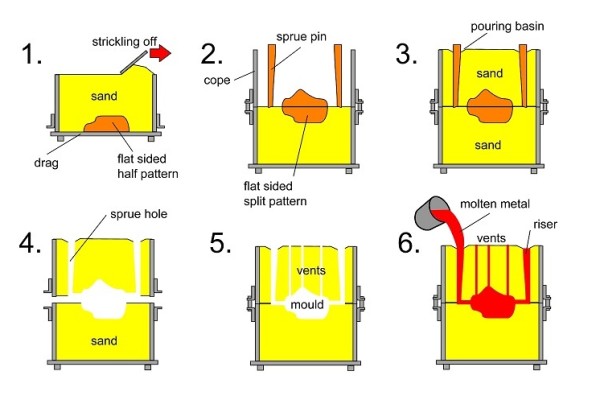
You’ll see this in the video at the end of this chapter.
Heating metals to a molten state is common in most manufacturing processes.
However, the manner in which the molten metal is process is what makes the process unique.
Here’s what we need to understand:
In sand casting process, you will pour the molten metal in the mold. In most cases, the flow is due to gravitational force/acceleration.
However, to remove cast parts, you’ll destroy/disassemble the mold. Thus, it’s associated with low production rate.
Generally, its basic requirements include:
- Mold cavity/ preformed cavity
- Material melting process
- Metal pouring procedure/technique
- Solidification process
- Removing cast parts
- Finishing draft allowance/operations
You will learn this in details next chapter .
We need to have a quick look at the history of sand casting manufacturing process first.
History of sand casting
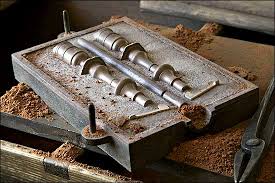
Sand casting is an ancient technology. It’s one of the oldest metal processing techniques adopted by most industries.
You should understand that sand casting forms an important part of industrial growth.
Clay molds, which are used in industries can be traced back to the 1600 and 1046BC.
This was during the Shang Dynasty. Again, by 681BC, king Sennacherib of Assyrian had cast over 30 tons of bronze.
Since then, the process has been adopted by a number of manufacturing companies .
Such as:
1.Ford; in 1924, Ford Automobile Company had produced about 1 million cars. This translated to about 33% of the total casting production in the U.S.A.
2.Beardsley and Piper invested sand slinger.
3.U.S. Army begun producing hand grenades by 1918.
These are just a few examples, but, what are we trying to say?
Sand casting has existed before and after industrial revolution.
Making it one of the oldest and versatile manufacturing technologies.
In fact, it plays an integral role in industrial growth and development.
As a matter of fact, the sand casting equipment is an evolution of a process that has survived in numerous cultures globally.
A lot of archaeological evidence show remains of sand cast items.
A clear indication that the early man, did cast a number of items.
In recent past, it was mainly used as a way to identify cultures or way of life.
The sand casting process we’ll discuss in this handbook is not different from the ancient process.
Basic principles have not changed throughout these years.
The whole idea of mixing fine sand with oil, packing and creating a desired mold has remained unchanged.
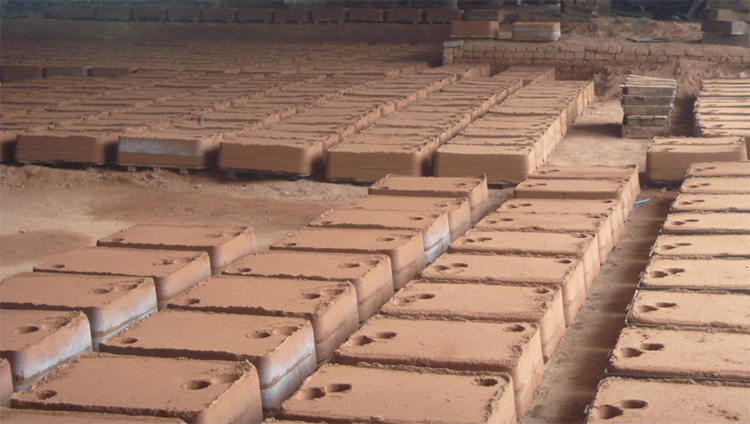
Similarly, heating metal to a desired temperature and pouring into the mold cavity is still the same.
Technological advancement is the only key feature we’ve witnessed over the years.
Of course, there are advancements in sand casting industry.
These include:
- Automation and computerization thus, enhanced production and efficient foundries.
- Improved mold construction and testing.
- Better handling equipment.
- Enhanced sand handling and conditioning procedures.
Again, we have to acknowledge that all technological improvements aim to increase production.
That is, quality finishes and shorter lead times.
Having looked at both the definition, history and a bit of the modern sand casting process, the practical bit is really important.
This will explained by a sand casting video at the end of this section.
Sand Casting Tolerances
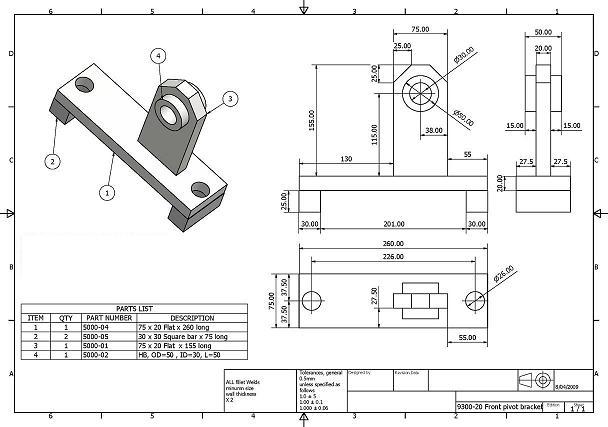
In all metal manufacturing processes, you need to consider required tolerance.
At times, this becomes such a complex process that may require advanced equipment.
Before we proceed, we should understand the meaning of sand casting tolerance.
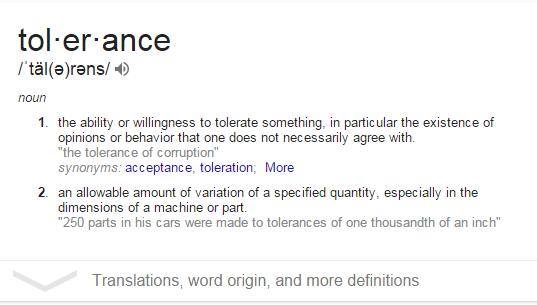
We use the term “tolerance” in engineering and metal fabrication to refer to the degree of accuracy.
The Dictionary.com defines it as “an allowable amount of variation of a specified quantity, especially in the dimensions of a machine or part.”
Therefore, sand casting tolerance is an important aspect we must pay attention to.
Assuming you want to produce a sand cast part, what are the most basic sand casting elements you should consider?
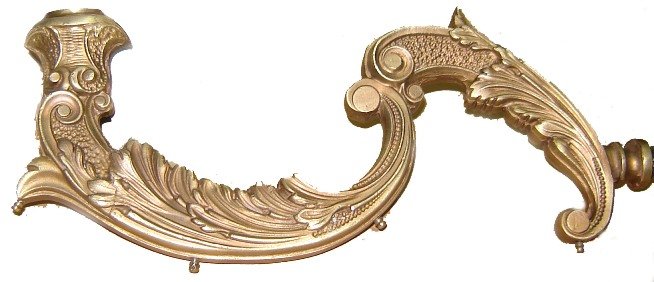
Let’s try to expound on this. It is a vital aspect to engineers and technicians.
You should consider the following key factors:
Draft Allowances
Draft is the angle on all vertical faces of the mold, making it easy to remove cast parts.
Under normal circumstances, draft is about 1.5°.
The size of draft angle will depend on: size of part, production method and technique (automated or manual process).
Machining allowance
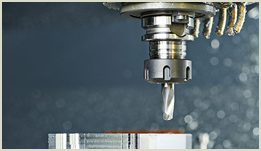
An appropriate finishing operation can be adopted for a sand casting process.
Machining allowances will depend on type of metal and tool used.
Factors that determine sand casting tolerance
In addition to the key elements we have mentioned above, dimensional tolerance of any sand cast part will depend on:
- Dimension length and casting weight.
- Part pattern and quantity of production.
- Design of the casting.
- Sand casting process.
- Required finishing criteria.
It is important that you discuss all these with the company of choice.
Reason being, companies adopt different manufacturing techniques to achieve desired sand casting tolerance.
Maybe all these seem technical for a layman. However, with the video below, you will understand all factors we have covered in this chapter.
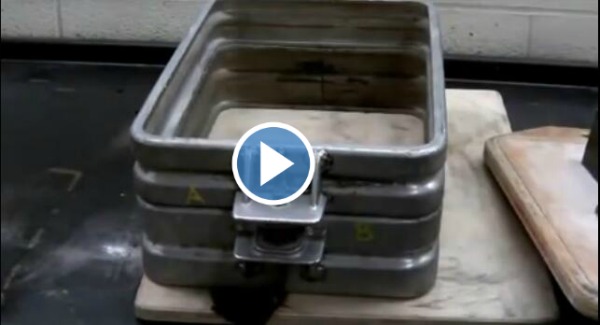
Sand casting video
A practical approach to the entire sand casting process is vital for both laymen and experts.
In this video, you will acquaint yourself with the basic skills and practical aspect of various aspects we have discussed above.
However, a detailed step-by-step sand casting process will be discussed in chapter two of this handbook.
The video, will be a prerequisite of the entire process.

Leave A Comment